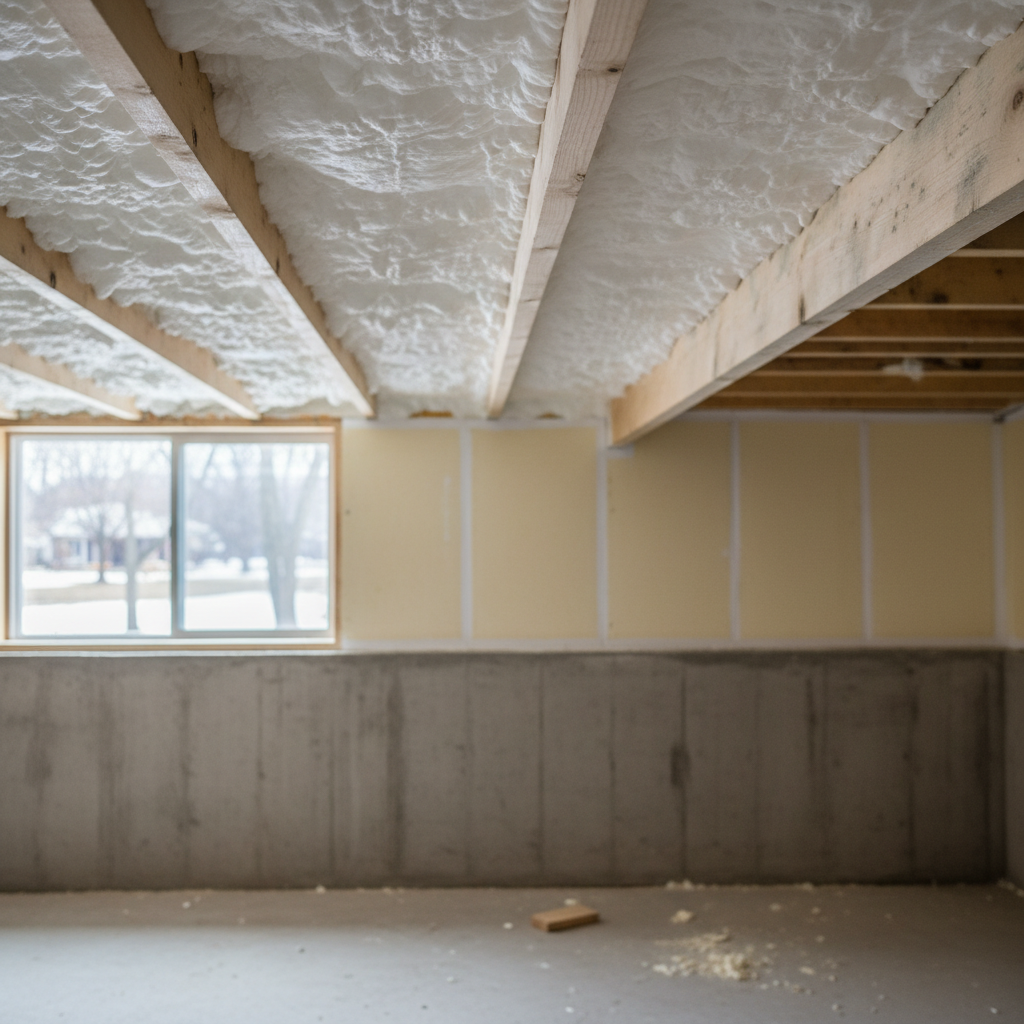
Walking down into a basement on a freezing January morning in Old West Side often brings a sudden drop in temperature. This happens because uninsulated or poorly insulated foundation walls act like massive heat sinks, dragging down home comfort and sending utility bills up. Rouge Oak Insulation of Ann Arbor receives many questions from local homeowners looking to fix cold floors and damp walls. The most common questions about Basement Wall Insulation in Ann Arbor, MI are answered below with straight information.
What R-value do I actually need for basement walls in Michigan?
Michigan building codes and local climate realities point toward specific targets for Basement Wall Insulation. For Climate Zone 5 and 6, code compliance typically calls for around R-10 to R-15 continuous insulation, or up to R-19 in wood-framed cavities. Hitting a strict code number on paper is different from stopping real-world heat loss. Because clay-heavy soils around Washtenaw County stay cold and damp well into the spring, aiming for higher performance on below-grade walls pays off in everyday comfort.
Should I insulate the basement walls or the basement ceiling?
The choice depends entirely on whether the basement is finished and heated. Homeowners using the space as a rec room, home office, or guest suite, or those with exposed water pipes that could freeze during a bitter Michigan cold snap, need to insulate the foundation walls. When a basement is strictly an unfinished utility and storage zone where the furnace lives, the ceiling joists can be insulated instead to keep the floor above warm. Insulating the ceiling leaves foundation walls exposed to freeze-thaw concerns and keeps the basement itself quite cold.
Can I use fiberglass batts against my concrete basement walls?
Fiberglass batts should not be used against concrete basement walls. Fiberglass and organic framing materials absorb moisture like a sponge, especially when placed against damp concrete foundations influenced by local clay soils. Wet fiberglass loses its insulating value entirely and turns into a breeding ground for mold and mildew. Homeowners finishing a basement need moisture-resistant materials like rigid foam boards or closed-cell spray foam that will not degrade when they encounter humidity.
What about the rim joists? Aren't those part of the basement?
Rim joists are part of the basement, and they are usually the draftiest spot in the entire house. The rim joist sits right at the top of the foundation wall where air leaks easily slip in and out. Sealing and insulating rim joists with closed-cell spray foam stops that cold draft dead in its tracks. Rouge Oak Insulation of Ann Arbor often sees homeowners spend money insulating walls while completely ignoring the rim joists, missing out on an easy energy win in the house.
Do I need a separate vapor barrier over my basement insulation?
The need for a vapor barrier depends on the material used. Installing closed-cell spray foam or extruded polystyrene rigid boards means those products have a low enough perm rating to double as their own vapor retarders. Adding an extra layer of poly sheeting over them can trap moisture against the concrete wall rather than letting it dry toward the interior, leading to hidden rot. Product guidelines should always be checked or a local trade professional consulted before layering barriers.
Will insulating my basement fix my wet basement problems?
Insulation does not fix wet basement problems. Insulation manages temperature and reduces condensation, but it is not waterproofing. Active leaks, bulk water pooling on the slab, or structural cracks letting groundwater through will cause insulation to just hide the damage and cause rot behind the scenes. Drainage must always be fixed, exterior soil graded away from the foundation, and cracks patched before putting up any Basement Wall Insulation system.